Nickel Strip Processing / 8 min read
Nickel 201 Strip & Nickel-Plated Tubing: Processing, Tolerances, and Export Supply
The supplier comparison usually comes down to four questions: which grade and UNS number is actually being quoted, what slit width and burr tolerance is guaranteed, what surface finishing and plating acceptance criteria
Quick Answer
The supplier comparison usually comes down to four questions: which grade and UNS number is actually being quoted, what slit width and burr tolerance is guaranteed, what surface finishing and plating acceptance criteria are documented, and what inspection evidence will arrive with the export package.
Key Takeaways
- Base substrate alloy and UNS number
- Nickel coating grade and minimum thickness
- Wear-zone thickness map if localized thickness is required
- Adhesion test method and result

# Nickel 201 Strip & Nickel-Plated Tubing: Processing, Tolerances, and Export Supply
The supplier comparison usually comes down to four questions: which grade and UNS number is actually being quoted, what slit width and burr tolerance is guaranteed, what surface finishing and plating acceptance criteria are documented, and what inspection evidence will arrive with the export package.
For procurement teams, the main risk is not price alone. It is material that meets a generic datasheet but fails an application-specific dimension, edge, finish, or traceability requirement. The correct product-form standard must also be confirmed: sheet, coil, strip, plate, pipe, tube, and bar are not interchangeable purchase categories.
Buyer takeaway: Confirm the exact UNS number, product-form standard, slit tolerances, surface-finish line items, plating thickness map, PMI evidence, and export packaging before order acceptance. Never accept the trade name “201” alone.
1. Grade Clarity: Nickel 201 Strip Is Not Stainless Grade 201 or a Copper-Nickel Alloy
Treating “201” as a single material is a common sourcing error. Stainless steel grades 201 and 202 are low-carbon stainless grades in which approximately half the nickel is replaced by manganese; their corrosion and mechanical properties are similar to type 304L stainless steel. That is not the same product as nickel 201 strip, which is a nickel-base wrought product and is often quoted as UNS N02201. Confirm the exact UNS number on the mill certificate and do not rely on the short trade name.
Nickel 201 strip should also not be confused with copper-nickel alloys. The C7xx wrought series covers copper-nickel and copper-nickel-zinc alloys, including nickel silvers. A C7xx designation on the quote means the material is a copper-based alloy, not Nickel 201. C8xx and C9xx designations refer to cast copper and copper-nickel alloys, not wrought nickel strip.
For purchase documentation, separate the product form clearly. In standard product-form tables, sheet, coil, strip, and plate are grouped under one standards family, while pipe and tube are referenced under separate product-form standards. The same logic applies to nickel alloys: do not use a strip standard for tubing or pipe.
2. Precision Slitting and Edge Control for Nickel 201 Strip
Slitting is not just a cutting operation. For nickel 201 strip used in electronics, precision battery components, or chemical-process parts, edge quality affects feeding, welding, cleaning, and downstream forming. The supplier must document the slitting method and confirm tool condition before production.
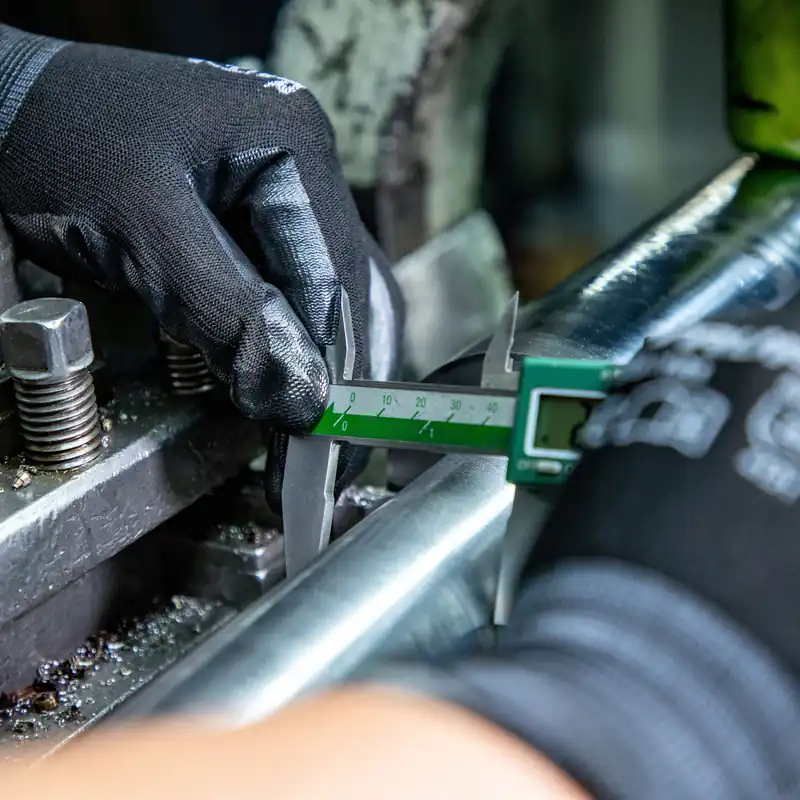
A practical RFQ target is width ±0.05 mm and burr height below 0.03 mm. Treat these values as buyer-defined acceptance criteria rather than assumed universal material standards. If the application is sensitive to edge contamination, specify cleaning after slitting and request evidence of controlled handling.
| Slitting parameter | Suggested RFQ requirement | Inspection evidence |
|---|---|---|
| Width | ±0.05 mm or narrower for critical strips | Dimensional report per coil or slit length |
| Burr | <0.03 mm unless otherwise agreed | Edge inspection or cross-section record |
| Camber | Supplier-defined mm per meter | Measured with straight edge or optical check |
| Edge condition | No cracks, splits, or heavy rollover | Visual and tactile incoming inspection |
If the product form is strip, the relevant general standard family for sheet, coil, strip, and plate includes ASTM A240 and A666. Verify the equivalent nickel-alloy standard for the exact product form, then add the private slitting acceptance criteria on top of that standard.
3. Surface Finishing: Electropolishing, Passivation, and Nickel Plating
Write surface finishing into the RFQ as separate operations. Electropolishing smooths the surface and may change final dimensions slightly. Passivation is a cleaning or protective step that depends on the substrate and final service environment. Surface roughness values for Nickel 201 strip are not universal. Request the achievable Ra or RMS value from the supplier before freezing the specification.
For nickel plated tubing, nickel coatings have historically been used where a bright, attractive, non-toxic surface is required. The coating can be deposited in greater thicknesses at points of maximum wear, such as at high-contact zones. That principle also applies to oem nickel pipe and plated tubing: mark wear zones on the drawing and require a coating-thickness map rather than a single average thickness.
Specify these items for plated tubing:
- Base substrate alloy and UNS number
- Nickel coating grade and minimum thickness
- Wear-zone thickness map if localized thickness is required
- Adhesion test method and result
- Final surface roughness for critical food or chemical contact areas
- Cleaning or passivation after plating
4. OEM Nickel Pipe: Manufacturing Route, PMI, and Dimensional Inspection
When sourcing oem nickel pipe, “nickel pipe” alone is not a complete purchasing description. Specify the manufacturing route, final condition, and acceptance tests. Cold drawing and annealing are commonly listed processing steps for tubular products, but the exact draw schedule, anneal temperature, atmosphere, and final hardness must be confirmed with the supplier before order acceptance.
Product-form separation is also critical for inspection. In the stainless steel reference table, pipe is listed under A312/A358/A409, while tube is listed under A213/A249/A269/A554. Apply the same product-form discipline to nickel alloy pipe and tube purchasing. Use the correct standard for the product form, and do not accept a strip certificate for pipe.
For each lot, require:
- UNS number and heat number
- Applicable ASTM/ASME product-form standard
- Dimensional inspection report for OD, wall thickness, length, and ovality where relevant
- Positive material identification or PMI result
- Mechanical test values, if required by the product standard
- Final surface condition after processing
- Cold drawing and annealing process records where applicable
Take hardness ranges and tensile properties from the applicable material standard for the exact product form, not from a generic commercial summary. Require certified values against the stated standard.
5. Applications: Electronics, Chemical, and Food Processing
Electronics applications usually require close gauge control, narrow width tolerance, and clean edges. Request slit-edge photographs or sample lengths before approving production. Do not assume electrical or corrosion performance data for Nickel 201 strip; ask the supplier for compatibility documentation for the intended environment.
For chemical processing, the main commercial concern is whether the material is compatible with the process stream and whether residual surface contamination from slitting or forming must be removed. Specify cleaning, passivation, or surface finish requirements by line item.
For food processing, nickel coatings were used in flatware because nickel gave a bright, attractive, non-toxic surface. Current food-contact compliance must be confirmed for the exact product construction and regulatory market. Ask the supplier for compliance statements covering the base material, the coating, and any final cleaning chemistry.
6. Buyer Decision Framework and RFQ Checklist
| Factor | Solid Nickel 201 strip | Nickel plated tubing |
|---|---|---|
| Base material | Nickel 201; confirm UNS N02201 and product-form standard | Substrate plus nickel layer; confirm base alloy and coating grade |
| Primary processing focus | Precision slitting, edge quality, surface finish | Tube forming, coating thickness, adhesion |
| Key failure mode to prevent | Burr-related feeding or welding defects | Coating holidays, thin spots, or adhesion loss at wear areas |
| Documentation focus | Width and burr reports, PMI, mechanical certification | Thickness map, adhesion test, PMI for substrate and coating |
Choose solid strip when the entire cross-section must be nickel or the part is formed from flat stock. Choose nickel plated tubing when the surface properties of nickel are needed on a different substrate, or when local nickel thickness can be concentrated at wear points to control cost.
Before issuing the purchase order, confirm:
- Exact grade and UNS number
- Product-form standard for strip, tube, or pipe
- Width tolerance and burr limit for nickel 201 strip
- Surface finish requirements: electropolishing and passivation
- Plating thickness, adhesion test, and wear-zone thickness map for nickel plated tubing
- Cold drawing and annealing route for OEM nickel pipe
- PMI and dimensional inspection required per lot
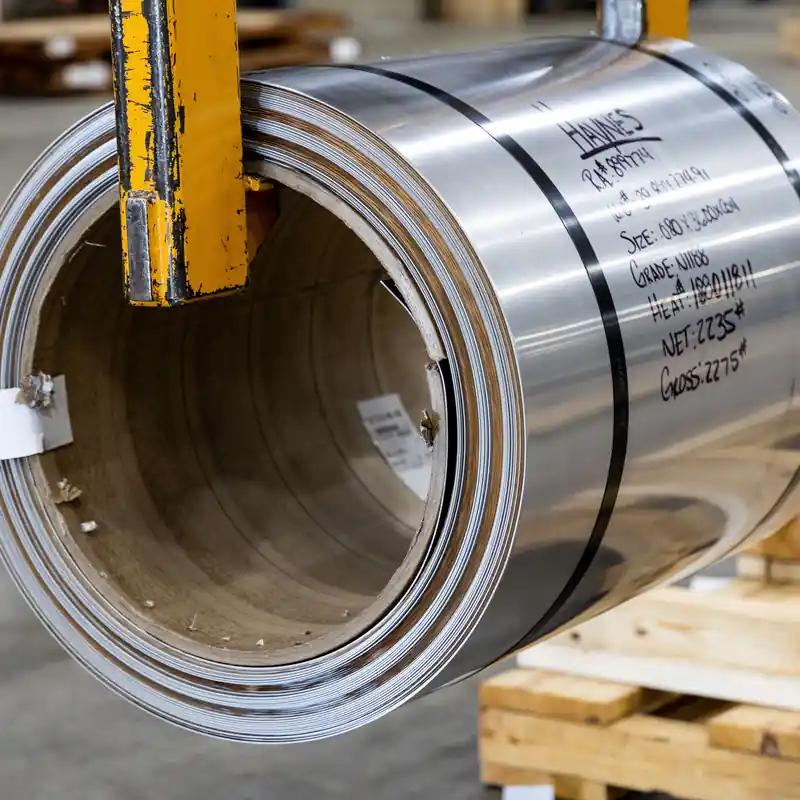
- Export packaging for coils and cut lengths
- Mill test certificate, certificate of conformance, and photographs or samples
Keep titanium or other special-alloy items on separate RFQ lines. For example, titanium grades such as Ti-3Al-2.5V-Pd (Grade 18) and Ti-3Al-2.5V-Ru (Grade 28) are distinct material families with palladium or ruthenium additions for crevice-corrosion resistance. Mixing them into a nickel-alloy package can create traceability, packaging, and pricing errors.